“My Wisdom Tooth Has a Cavity and It Hurts — Does It Have to Come Out?”
A real root canal case from our practice: why we saved a wisdom tooth instead of removing it — and how to tell whether yours is worth saving.
The short answer
Not always. A painful, decayed wisdom tooth is often removed, but it does not have to be. If the tooth has fully come through, sits in healthy gum and bone, can be reached comfortably with the mouth open and still does useful chewing work, a root canal followed by a crown can keep it. Saving it matters most when the teeth in front of it are already missing or weakened — exactly the situation in this case, where the first molar was missing and the second molar had already had a root canal.
This case at a glance
- What the patient reported
- A cavity and pain in a wisdom tooth (the third molar, the last tooth at the back of the jaw).
- Diagnosis
- Deep decay on the biting surface that had reached the pulp (the nerve), with tenderness to tapping — the inflammation had spread to the tissues around the root.
- What changed the decision
- The first molar on the same side was missing, and the second molar had already had a root canal. The wisdom tooth was one of only two molars left on that side.
- Treatment plan
- Root canal treatment of the wisdom tooth, then crowns on both the wisdom tooth and the second molar. Extraction was offered as the alternative.
- Where it stands
- Root canal treatment of the wisdom tooth carried out; crowns are part of the plan. Follow-up will be published on this page.
In this article
What did the patient come in with?
The complaint was simple: a cavity and pain in a wisdom tooth. Many people in this position arrive expecting the tooth to be pulled out — wisdom teeth have a reputation for being expendable. Sometimes they are. In this mouth, the rest of the picture changed the answer.
What did we find on examination?
- A deep cavity on the biting surface of the wisdom tooth. Clinically this is a Class I cavity — decay that starts in the grooves of the chewing surface and works its way down.
- Pain when the tooth was tapped. Tenderness to tapping tells us the inflammation is no longer confined to the inside of the tooth; it has begun to affect the tissues around the root.
- An X-ray showing the decay had reached the pulp — the nerve and blood supply in the centre of the tooth. Once decay reaches the pulp, a filling alone can no longer fix it.
- A missing first molar on the same side of the jaw.
- A second molar that had already had root canal treatment, restored with a large filling but no crown.
- Good mouth opening and good access to the back of the mouth — a practical requirement for working on a wisdom tooth.
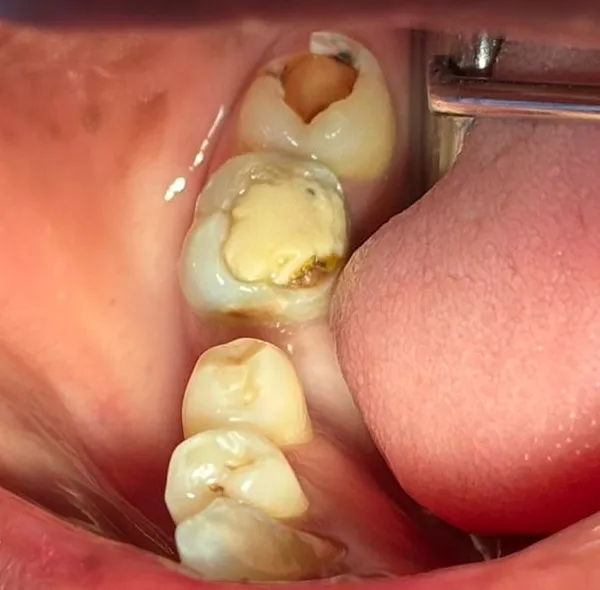

Clinical photograph and radiographs from this case, published with consent and with identifying features removed. Every mouth is different; these images illustrate one patient’s presentation and are not a diagnosis of yours. All images on this page are shown for education and awareness purposes only.
Why does a cavity in a wisdom tooth start to hurt?
A cavity on the chewing surface is painless for a surprisingly long time, because enamel has no nerves. The trouble starts when decay breaks through into the softer dentine underneath and then into the pulp. Bacteria reaching the pulp cause it to become inflamed; because the pulp is sealed inside a rigid shell, that swelling has nowhere to go, and it hurts — often as lingering sensitivity to hot or cold, pain at night, or pain on biting.
Wisdom teeth are especially prone to this. They sit furthest back, where a toothbrush reaches least well, and their deep grooves trap food. Decay there is frequently found late, when it is already close to the nerve.
Should a painful wisdom tooth be removed or saved?
It depends on what the tooth is doing and what is around it. Two plans were discussed with this patient.
Plan 1 — Save the tooth: root canal treatment, then crowns
This was the recommended option, for three reasons specific to this mouth:
- The first molar was already missing. The first molar is normally the main chewing tooth on each side. Without it, the second and third molars are carrying that side of the jaw.
- The second molar was already root-canal treated. A root-filled tooth is more brittle than a healthy one. Removing the wisdom tooth would have left a single weakened molar doing all the back-tooth work on that side.
- The practical conditions were good. The patient could open wide, the tooth could be reached comfortably, and the X-ray showed a tooth that could be treated and restored.
In other words, the value of a wisdom tooth depends on what is around it. In a mouth with a full set of healthy molars, this tooth might have been the easy one to lose. In this mouth, it was one of only two molars left on that side.
Plan 2 — Remove the tooth
Extraction was a legitimate alternative and was offered. It is quicker and removes the problem in one visit, but it would have cost the patient chewing surface on a side that had already lost a tooth, and left the previously treated second molar to take the full load alone.
The decision principle, in one line
A wisdom tooth is judged by the job it can still do, not by its name. When the teeth in front of it are missing or weakened, it may be one of the most valuable teeth in the mouth.
What did the treatment involve?
-
Root canal treatment of the wisdom tooth
Under local anaesthetic
The decay was removed and the pulp chamber opened. The infected and inflamed pulp tissue was cleaned out of the root canals, and the canals were shaped and disinfected. Fine instruments were placed in the canals and an X-ray taken to measure their exact length, so that cleaning and filling reach the end of each root and no further. The canals were then sealed with a filling material.
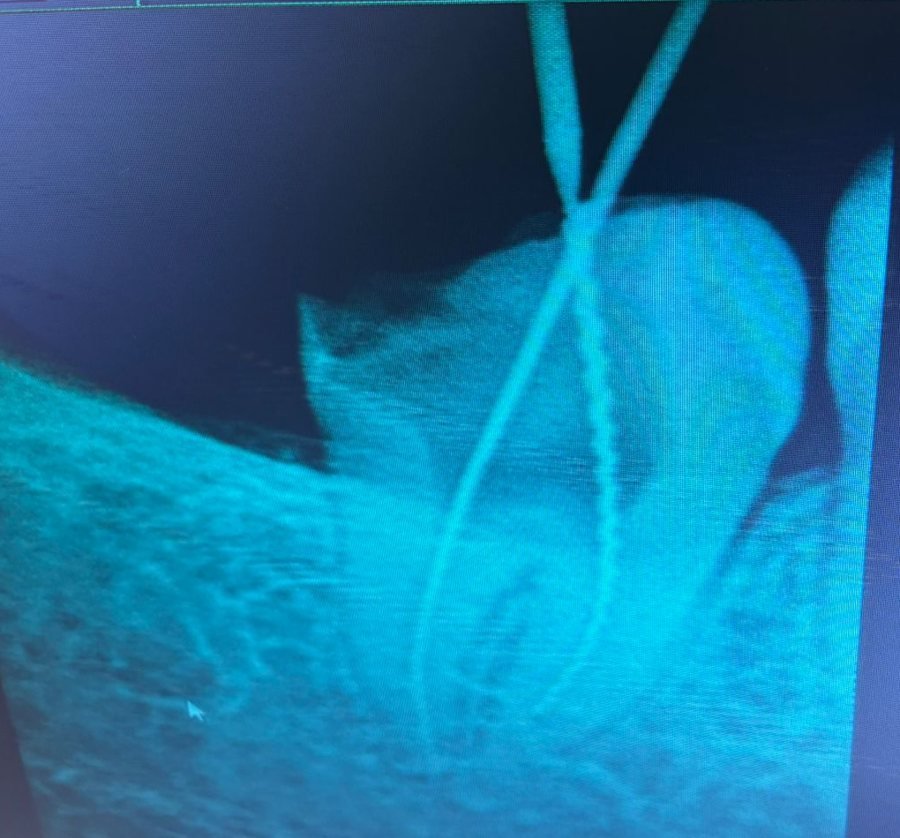
During treatment: fine instruments in the root canals and an X-ray taken to confirm their length before the canals are cleaned and filled. Image for education and awareness purposes only. -
Crowns on both the wisdom tooth and the second molar
After the root canal
Once a back tooth has had a root canal, it is hollowed out and more brittle, and the forces of chewing can split it. A crown — a cap that covers the whole biting surface — holds the tooth together. The plan caps both molars on this side: the newly treated wisdom tooth, and the second molar, which had been root-canal treated earlier but never crowned. With the first molar missing, those two teeth now do most of the chewing on this side, so protecting both matters.

What about the missing first molar?
Replacing it — with an implant or a bridge — was discussed. The patient chose not to replace it at this time, which is the patient’s decision to make. Leaving a gap is not an emergency, but it is worth understanding what it can lead to over the years, and the option to replace it remains open. See crowns and bridges and dental implants for how a missing tooth can be replaced.
An honest caveat
Root canal treatment on a wisdom tooth is more demanding than on a front tooth. The tooth is harder to reach, and wisdom teeth have the most variable root anatomy in the mouth — fused roots, curved roots and unexpected extra canals are common. For those reasons the long-term outlook is judged case by case, and a root canal on a wisdom tooth is not the right answer for everyone. If a treated tooth develops problems later, removal is still available as a fallback. Saving the tooth first keeps that choice open; removing it first does not.
When is saving a wisdom tooth worth it — and when is removal better?
A wisdom tooth is worth saving when it is upright, functional and restorable, especially if neighbouring molars are missing or weak. Removal is usually better when it is impacted, has nothing to bite against, or cannot be reached safely.
| Saving it is worth considering when… | Removal is usually the better choice when… |
|---|---|
| The tooth has fully erupted and sits upright in the arch | The tooth is impacted, partly buried or growing at an angle |
| It has an opposing tooth to bite against and does real chewing work | It has nothing to bite against and does no useful work |
| Neighbouring molars are missing or already weakened | A full set of healthy molars is already doing the chewing |
| The patient can open wide and the tooth can be reached | Limited mouth opening makes treatment unsafe or unreliable |
| Gum and bone around it are healthy and the tooth can be restored | Gum disease, bone loss or decay make it unrestorable |
| It may be useful later, for example to support a bridge | It keeps trapping food and causing gum infections (pericoronitis) |
General guide only; the decision is made tooth by tooth after an examination and X-ray.
What are the signs a cavity has reached the nerve?
- Sensitivity to hot or cold that lingers for more than a few seconds after the drink is gone
- Toothache that starts on its own, or wakes you at night
- Pain when biting down, or when the tooth is tapped
- A dark spot or visible hole in a back tooth, especially one that catches food
- Swelling of the gum near the tooth, or a small pimple on the gum
- Pain that used to come and go and has now stopped — which can mean the nerve has died, not that the problem has gone
None of these always means a root canal is needed. All of them are worth an examination and an X-ray, and the earlier decay is found, the smaller the treatment tends to be. Read more about root canal treatment at our clinic.
Common questions from patients
Can a root canal be done on a wisdom tooth?
Yes. Wisdom teeth can be root-canal treated in the same way as other molars, provided the tooth has fully erupted, can be reached with the mouth open, and is worth keeping. It is technically more demanding because of the tooth’s position and its variable root shapes, so the decision is made tooth by tooth after an examination and X-ray.
Isn’t it simpler just to remove a wisdom tooth?
It is often quicker, and for impacted or non-functional wisdom teeth removal is usually the right choice. But a wisdom tooth that is upright, biting against another tooth and supporting a side of the mouth that has already lost teeth is doing a real job. Once it is removed, that chewing surface is gone for good.
Why did my tooth hurt when the dentist tapped on it?
Tenderness to tapping usually means the inflammation has spread from the pulp inside the tooth to the tissues around the root tip. It is one of the signs that tells the dentist a filling alone will not be enough and the inside of the tooth needs treatment.
Why does a back tooth need a crown after a root canal?
A root canal removes the tooth’s inner tissue and, often, a large amount of decayed structure. The remaining tooth is more brittle, and back teeth take heavy chewing forces. A crown covers and holds the tooth together, which lowers the risk of it cracking or splitting.
Why a crown on the second molar too, when it wasn’t hurting?
The second molar had already had a root canal but had only a filling, so it carried the same fracture risk as any uncrowned root-filled back tooth. With the first molar missing, it was also taking extra chewing load. Capping it protects a tooth this side of the mouth depends on.
What happens if I don’t replace a missing back tooth?
Nothing dramatic happens straight away. Over time, the teeth behind the gap can tilt forward into it, the tooth above or below can drift towards the empty space, and the remaining teeth take more chewing load. Whether and how to replace it is the patient’s choice, and the option usually remains open for years.
Does a root canal hurt?
The treatment is carried out under local anaesthetic, and most patients describe pressure and vibration rather than pain during it. Tenderness when biting for a few days afterwards is common and usually settles with simple painkillers. The toothache that brings people in is usually worse than the treatment.
How long will a root-canal-treated wisdom tooth last?
There is no fixed number and no honest dentist will promise one. A well-sealed root canal protected by a crown, with good cleaning at the back of the mouth and regular check-ups, can serve for many years. Wisdom teeth need particular attention with brushing and flossing because they are the hardest teeth to reach.
Where are we with this case?
The wisdom tooth has been root-canal treated, and crowns on both the wisdom tooth and the second molar are part of the plan. The patient chose not to replace the missing first molar for now. We will add the follow-up X-ray to this page at the review appointment, so readers can see how the treated tooth is doing rather than taking a promise on trust.
Last updated:
A painful or decayed wisdom tooth?
Book a check-up and X-ray at either clinic. We’ll tell you honestly whether the tooth is worth saving.
+91 88606 92858
Mon–Sat 9:00 AM–1:00 PM and 5:30–8:30 PM
Sunday 11:00 AM–1:00 PM (by appointment) Pitampura, New Delhi 134, Anand Vihar, Pitampura, New Delhi 110034
+91 88003 59795
Mon–Sat 9:00 AM–1:00 PM and 6:00–9:00 PM
Sunday 11:00 AM–1:00 PM (by appointment)
Medically reviewed by Dr. Yatharth Bhatia, BDS, MDS, Prosthodontist and Implantologist, Dr. Bhatia’s Dental Clinic, on . Published .
Image disclaimer: The clinical photograph and X-rays on this page are shown for education and awareness purposes only. They are published with the patient’s consent, with all identifying features removed, and illustrate one patient’s case. They are not a diagnosis of your condition and do not promise a particular result.
Medical disclaimer: This article describes one patient’s presentation and treatment and is published for general education. It is not a substitute for an in-person examination by a dentist. Individual results vary.